Exercise Physiology for Sports Nutritionists - Institute of Performance Nutrition Exercise Physiology for Sports Nutritionists - Institute of Performance Nutrition

APPLICATIONS NOW OPEN FOR MAY 2026 INTAKES

100% online
IOPN CertificateEQF Level 6 Equivalent

Exercise Physiology for Sports Nutritionists

Develop a comprehensive understanding of exercise physiology and how to apply it in the design and delivery of individualised sports nutrition strategies.

 
Apply for May 2026

Why pursue this programme?

For current and aspiring sports nutritionists — this programme develops your exercise physiology knowledge and prepares you for applying it with confidence in practice.

Personal Trainers and Strength and Conditioning Coaches

You're already working supporting clients to achieve their goals. Enhance your understanding of the relationship between training adaptation and nutrition to improve athlete health, recovery and performance.

Nutritionists and Dietitians

You've solid foundations in nutrition. Enhance your understanding of exercise physiology and learn how to apply the science into your practice following the completion of this programme.

Changing career?

Hold a degree in an unrelated discipline? This programme provides the foundations required to bridge into sports nutrition and postgraduate study.

Trusted by sports nutritionists worldwide


About this programme

Delivering impactful nutrition strategies requires the practitioner to have a strong understanding of several important disciplines – exercise physiology being one. How nutrition interventions are applied in practice requires the practitioner to understand and consider a range of factors: the type of training being undertaken, the performance demands of the sport, and importantly, their scope of practice as the practitioner delivering the support. The ability to translate the relevant theory into highly personalised strategies is what separates good practitioners from great ones.
Delivered 100% online over three months, the programme is built on the IOPN’s three-step learning framework covering exercise physiology theory, its translation to sports nutrition practice, and expert-led real-world case studies that develop your ability to apply the science with confidence.
 

Programme highlights

  • Study flexibly 100% online—designed to fit around work and personal commitments.
  • Complete in 3 months around your full-time work and other commitments.
  • Learn from the industry leading Institute of Performance Nutrition.
  • Access to international journals and IOPN learning resources.
  • Direct progression pathway to the IOPN’s PGDip and MSc (top-up) postgraduate programmes.


Modules explained

Across four modules, you will develop the critical thinking and theoretical knowledge needed to evaluate research, understand how the body responds and adapts to exercise, and apply evidence-informed reasoning to support athlete performance and health. This programme will prepare you for the demands of postgraduate study with the IOPN.
Module 1: Physiology of Sports Performance
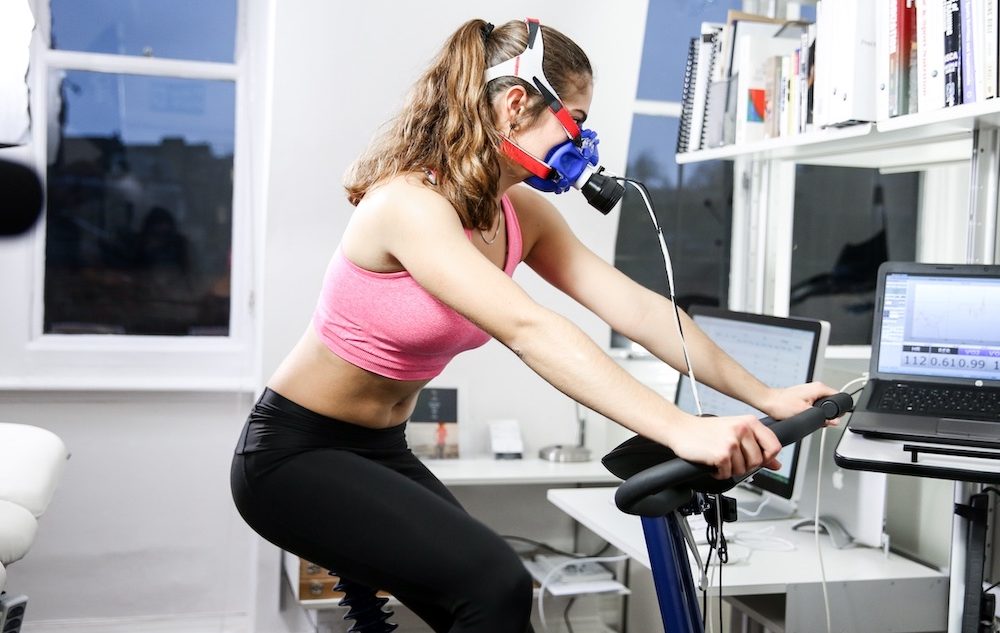
This module provides an introduction to the physiological foundations of sports performance. Students will examine cardiovascular and respiratory responses to exercise, energy system integration, VO₂max, VO₂ kinetics, and exercise economy, alongside the key physiological determinants of performance.

Students will also be introduced to the measurement of these variables, including laboratory and field-based assessments, and will develop the ability to interpret physiological data (e.g., VO₂, submaximal responses) and think about how this helps inform training intensity, pacing, and nutritional strategies.

The module emphasises the application of physiological principles to real-world contexts, enabling students to explain how acute responses and chronic adaptations to endurance, high-intensity, and resistance training influence performance outcomes.

Module 2: Fundamentals of Energy Metabolism
This module explores the principles of human energy metabolism and their relevance to sports nutrition practice. Students will examine the role of ATP in energy provision, the metabolic pathways governing carbohydrate, fat, and protein utilisation, and the hormonal regulation of metabolism during exercise.

Students will develop an understanding of how substrate utilisation changes with exercise intensity and duration, and how this can be assessed using methods such as indirect calorimetry and estimation approaches. Emphasis is placed on interpreting metabolic data (e.g., RER, substrate oxidation rates) which is used in the planning and evaluation of nutritional strategies.

Module 3: Exercise and Fatigue
This module examines the physiological and neurological mechanisms contributing to fatigue during exercise. Students will explore central and peripheral fatigue, the functional properties of skeletal muscle, and the processes underlying force production and fatigue development.

The module focuses on understanding how fatigue manifests at the whole-body and muscular level, and how this influences performance during different types of exercise. Students will apply this knowledge to identify key limiting factors (e.g., substrate depletion, neuromuscular fatigue, metabolite accumulation) and consider their implications for pacing, training, and nutritional support.

Emphasis is placed on translating physiological mechanisms into practical strategies to delay fatigue, support recovery, and maintain performance.

Module 4: Applied Physiology for Sports Nutrition
This module examines applied topics at the intersection of exercise physiology and sports nutrition. Students will explore the physiological responses to exercising in challenging environments, including heat and altitude, with a focus on thermoregulation, fluid balance, and their impact on performance. The module also addresses contemporary topics such as, carbohydrate availability, individual variability in physiology, sex differences and female athlete physiology, linking underlying physiology to nutritional practice.

Students will integrate knowledge from across the programme to evaluate real-world scenarios and develop evidence-informed strategies. The module culminates in an applied case study assessment in which students demonstrate their ability to interpret physiological and nutritional information to support athlete performance.


Key points

Learning outcomes
On successful completion of this programme, students will be able to demonstrate knowledge and understanding of:

  • Key subject-specific terminology, concepts, and models in exercise physiology and nutrition
  • Methodological techniques used in sport and exercise contexts
  • The links between physiology, metabolism, nutrition, and exercise performance

Assessments
Assessments throughout the programme include case-based assignments (data interpretation and written reports), multiple-choice questions, recorded oral presentations, and vivas conducted via video call with an assessor.
Entry requirements
You can apply for this programme through one of two routes:
 
Route 1: You hold an undergraduate degree
You hold an undergraduate degree (or international equivalent), whether that’s in a related discipline or a subject outside of sport, nutrition, or life sciences — for example, business, education, psychology, or humanities.
 
Route 2: Portfolio application
Applicants who do not hold an undergraduate degree may apply via the portfolio pathway. To be considered, you will need to demonstrate completion of multiple relevant professional qualifications — for example in nutrition, personal training, strength and conditioning, or a related health or performance field.

Your portfolio should provide evidence of qualifications across EQF Levels 3, 4, 5, and 6, and must demonstrate progressive academic and professional development rather than a single qualification at one level.

In addition, applicants must demonstrate having obtained practical experience, for example at least one year of experience working in sports nutrition, personal training, strength and conditioning, or a similar discipline.

Portfolio applications are assessed on an individual basis by the IOPN admissions team. If you are unsure whether your qualifications meet the criteria, we encourage you to get in touch — our admissions team will review your background and advise accordingly.
 
English language requirement
All applicants need to demonstrate English proficiency at IELTS 6.5 (CEFR C1) level. If you’ve completed an undergraduate or postgraduate degree taught in English within the last five years, this is accepted in place of an IELTS certificate.

Who is this programme for?

  • Graduates with non-related degrees who want to transition into sports nutrition and progress to postgraduate study in the field.
  • Experienced practitioners with sports nutrition qualifications (e.g., nutrition coaching certifications) who seek knowledge in exercise physiology and how to apply it in practice.
  • Aspiring nutritionists who want to build a comprehensive foundation in exercise physiology without immediately committing to postgraduate study.
  • Current coaches and trainers seeking to deepen their understanding of the physiological principles that drive nutrition strategies for performance.
  • Sports nutrition and sport science graduates looking to refresh or consolidate their exercise physiology knowledge and its application in contemporary sports nutrition practice.

Exercise Physiology for Sports Nutrition

Duration3 months
IntakesFebruary, May, August, November
AwardIOPN Certificate
EQF equivalentLevel 6
Learning time300 hours
Format100% Online Distance Learning
LanguageEnglish
Tuition Fee£1,250 + applicable VAT
FinancingFlexible plans available

Apply today

Considering Postgraduate Study?

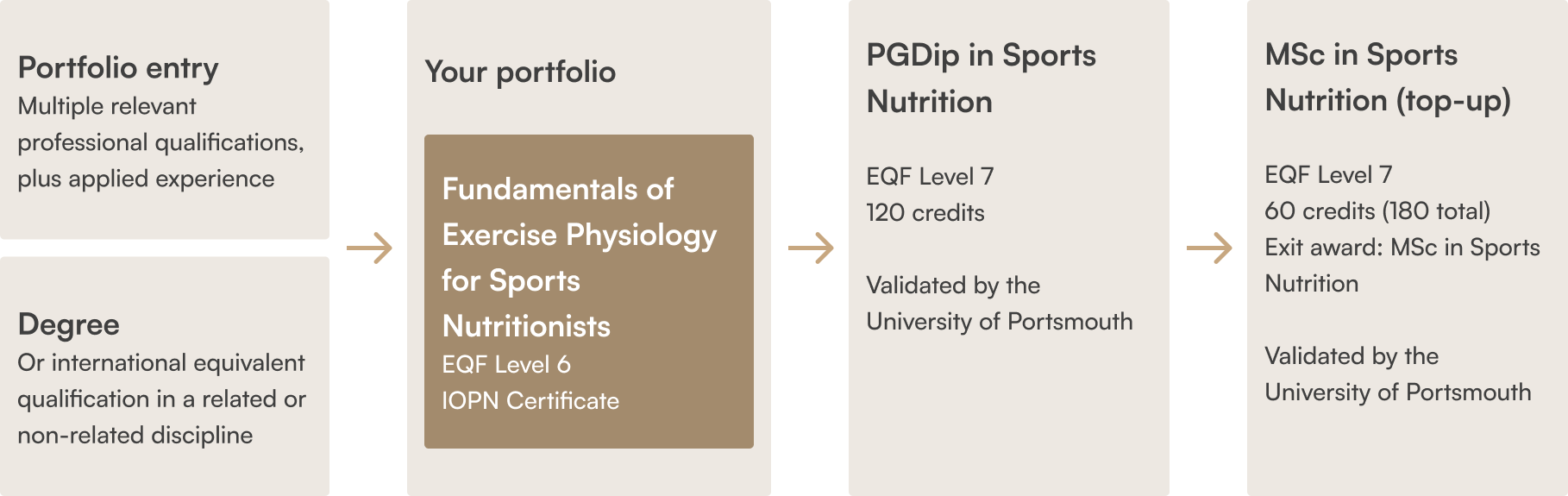
Completion of this programme will contribute towards your portfolio application should you wish to apply for the IOPN’s PGDip in Sports Nutrition and MSc in Sports Nutrition (Top-Up) pathway.

Limited places

Apply to join our May 2026 intake

Apply today

Progression pathway


Progress on to the IOPN's PGDip in Sports Nutrition
Upon successful completion of this programme, this IOPN Certificate will contribute towards your portfolio alongside your existing degree and/or other professional qualifications. Following completion of the IOPN PGDip in Sports Nutrition, learners can progress on to the MSc in Sports Nutrition (Top-Up) to achieve the final exit award: MSc in Sports Nutrition.

Enhance your current practice
Already working in coaching, personal training, or nutrition? This programme deepens your understanding of the physiological principles that drive effective nutrition strategies — giving you greater confidence and credibility when working with clients and athletes.

IOPN graduates go on to fuel the health, recovery and performance of elite athletes worldwide

England Rugby logo
Chelsea FC logo
Scottish Rugby
Canada Basketball logo
Team GB
Toronto Maple Leafs

Fees

Fair, transparent pricing for all, whether you're in the UK or overseas.
We're proud to lead the way in delivering world leading world leading training and education in sports nutrition globally.

Pay in full

£1,250 + applicable VAT

Split into 2 instalments

Tuition Fee can be paid in two monthly instalments of £635

Split into 3 instalments

Tuition Fee can be paid in three monthly instalments of £425

FAQ


Who is this programme designed for?
This programme is designed for fitness professionals, allied health practitioners, and career changers who want to build a rigorous, degree-level foundation in the physiological and metabolic principles underpinning sports nutrition practice. It is particularly well suited to:

  • Personal trainers and fitness professionals looking to formalise their nutrition knowledge at degree level
  • Strength and conditioning coaches seeking a deeper understanding of the relationship between training physiology and nutritional strategy
  • Allied health practitioners wishing to expand their knowledge into sports nutrition
  • Those holding a degree in an unrelated discipline who wish to pursue a career in sports nutrition
  • Anyone building their portfolio to apply for the IOPN’s PGDip in Sports Nutrition

What are the entry requirements?
Applicants are expected to hold an undergraduate degree or equivalent. This may be in a relevant discipline — such as sport and exercise science, physiology, nutrition, or a related health or performance field — or in an unrelated discipline, provided the applicant can demonstrate a clear motivation to pursue a career in sports nutrition.

Applicants without an undergraduate degree may be considered via the portfolio route, provided they can demonstrate a sustained record of professional development spanning EQF Levels 3, 4, 5, and 6. Please refer to the Portfolio Applications section above for further detail.

If you are unsure whether your background meets the entry requirements, we encourage you to apply — our admissions team will review your application and advise accordingly.

How do I apply?
To apply, complete the application form on this page. You will be asked to provide details of your academic and professional background, along with a cover letter outlining your motivation for undertaking the programme. Our admissions team will review your application and be in touch within 3 – 5 working days.
How much does the programme cost and how do I pay?
Programme fees are listed in the Fees section of this page. Payment is made securely via Stripe. You will have the option to pay in full or spread the cost across 2 or 3 instalments. Full pricing details, including instalment options, are available in the Fees section above or can be found here: theiopn.com/fees.
How is the programme assessed?
Assessment varies across the four modules and is designed to reflect the academic rigour of Level 6 study. Assessment methods include presentations, applied case studies, reflective practice and multiple choice questions.
Does completing this programme allow me to progress to the PGDip in Sports Nutrition?
Upon successful completion of this programme, this IOPN Certificate will contribute towards your portfolio alongside your existing degree and/or other professional qualifications. Following completion of that programme, learners can progress on to the MSc in Sports Nutrition (Top-Up) to achieve the final exit award: MSc in Sports Nutrition.